The Megaproject Boom Is Real. The Controls Discipline Is Not Keeping Up.
ConstructConnect’s April 2026 Construction Economy Brief reports that megaprojects are up more than 500% year-to-date, with nonresidential building construction up approximately 80% compared to the same period last year. The brief identifies an additional $32 billion in construction opportunities coming from sectors outside of data centers, distributed across eight subcategories of nonresidential and civil work. Construction owners
The numbers are real. The problem is that the controls maturity required to deliver projects at this scale and complexity is not scaling with them.
This is the part of the megaproject story that doesn’t make the headline. A $1 billion project is not a $200 million project times five. The complexity scales nonlinearly. The number of trades, the procurement cycles, the regulatory touchpoints, the stakeholder count, and the schedule logic density all increase faster than the project budget. A controls function that worked fine on a $200 million job becomes inadequate on a $1 billion job for reasons that aren’t visible until the project is well underway.
We’re seeing this pattern across the Mid-Atlantic, particularly in the DC-Baltimore corridor where data center and life sciences megaprojects have been concentrating. The owners commissioning these projects are sophisticated. They have capable internal teams. The challenge isn’t capability. It’s that the controls infrastructure they built for their previous capital programs wasn’t designed for the project size they’re now delivering.
Is your reporting actually surfacing these costs?
Stelic builds owner-side project controls that track soft-cost and schedule burn from day one. Not at closeout.
Three places the gap shows up
Procurement timelines that don’t reconcile with the schedule. Long-lead equipment on data center work has stretched past 60 weeks on certain configurations of electrical switchgear. Mechanical equipment routinely runs 38 to 52 weeks. On a megaproject, procurement isn’t a parallel track that the GC manages. It’s the schedule’s primary driver, and it has to be sequenced as a controlled function from the owner side. Most owners haven’t restructured their controls function to reflect this. Procurement sits with one team, schedule sits with another, and the two reconcile late or not at all.
Reporting that scales linearly when it should scale logarithmically. A project five times larger doesn’t need a report five times longer. It needs a report with the same number of decision-relevant data points and a much deeper underlying record. Most owners do the opposite. The monthly report grows with the project, KPIs proliferate, and the executive team ends up reading less of it as the project gets bigger and the stakes get higher. The fix is to write the executive reporting standard before the project starts, not after the first quarter when the report has already gotten unwieldy.
Risk registers that were never designed for this scale of exposure. A risk register with twelve active items works on a $200 million project. On a $1 billion project, the same twelve items aren’t sufficient. Not because there are more risks (though there usually are), but because the dollar exposure of each risk is much larger and the granularity required to manage it is correspondingly higher. Owners managing megaprojects with the risk discipline they used on smaller projects are exposed in ways they often don’t see until a risk becomes an actual cost.
What this means right now
The window for fixing this is narrow. The projects are starting. The contracts are being awarded. The controls structures that get put in place at project initiation are the ones that will run for the next three to five years.
The right move for owners commissioning megaprojects in 2026 is to treat the controls function as a project of its own, with its own budget and its own staffing decisions, before the construction work scales up. The diversification ConstructConnect describes, with $32 billion in opportunity outside data centers, means this isn’t only a hyperscaler problem. Education, healthcare, public safety, and infrastructure megaprojects are all surfacing the same controls gap. Constructionowners
Three concrete moves owners can make in the next 90 days:
Audit the controls function against the project size. The controls structure that ran a $200 million program is not automatically the right structure for a $1 billion one. Specific questions to ask: Is procurement integrated with scheduling at the controls level, or are they separate functions? Does the monthly executive report fit on one page, or has it grown with the project? Is the risk register active, ranked, and reviewed monthly, or is it a static document?
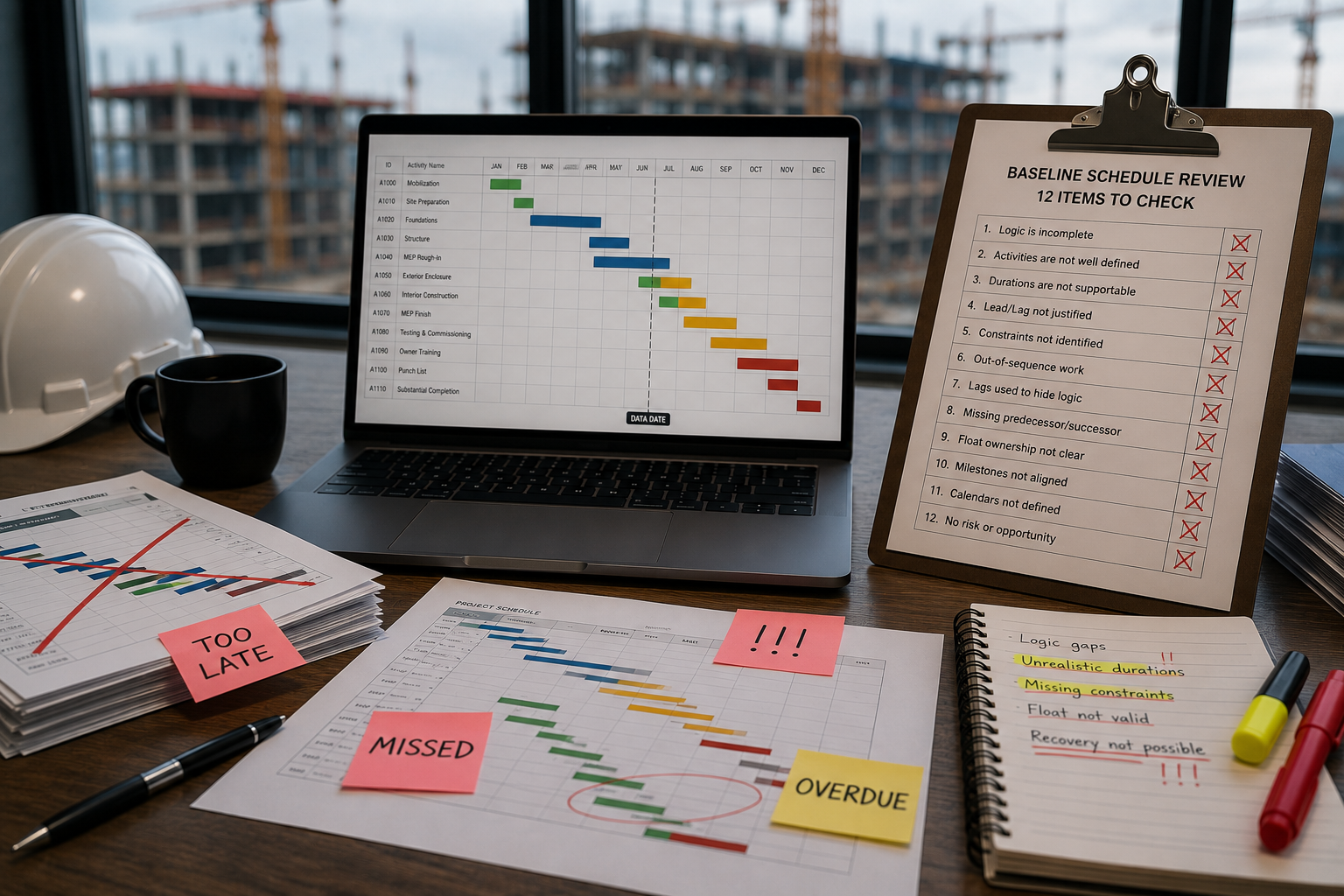
Set the schedule defensibility standard before construction starts. Megaprojects are dispute targets. The likelihood that a $1 billion project will produce at least one significant claim during its lifecycle is high, regardless of how well it’s run. The discipline that makes a schedule defensible clean logic, justified constraints, documented baselines, written narratives has to be required at project initiation. Adding it later doesn’t work. The AACE Recommended Practice 29R-03 covers the forensic standard for owners who want their schedules to survive analysis.
Decide which controls work happens in-house and which is owner-side independent. Most owners use some combination. The decision matters more on megaprojects because the dollar value of getting it wrong is larger. Independent project monitoring and controls oversight on megaprojects is not redundant with the contractor’s controls function. It’s the structural separation that produces the defensible record.
The pattern
Construction economic data tends to read as good news or bad news. The April brief is good news. Strong investor confidence and a renewed focus on large-scale infrastructure and commercial developments is the right environment for owners with capital projects to deploy. Constructionowners
It’s also the environment where controls discipline is most likely to be skipped. The work is moving fast. The bids are competitive. The contracts are large. The temptation to staff lean on the controls side and put the budget into the field is real, and it’s exactly the wrong move. The projects that will look like successes in 2029 are the ones where the controls function was set up correctly in 2026, when the work was starting. The ones that will become claims and disputes are the ones where it wasn’t.
For owners in the Mid-Atlantic running megaprojects through this cycle, Stelic’s project controls and program management practices work specifically on this gap. The discipline doesn’t have to be invented. It has to be required and staffed early enough to matter.
Stelic provides owner-side construction management, project controls, and program management on complex capital projects across life sciences, data centers, federal infrastructure, and healthcare in the DC-Baltimore corridor and across the Mid-Atlantic.