Where Capital Projects Actually Lose Efficiency — And Where Consulting Firms Can’t Help
Most articles about construction efficiency are written for contractors. They focus on the build phase, where efficiency is measured in crew productivity, material waste, and equipment utilization.
Owner-side efficiency is a different problem. By the time a capital project reaches the field, 60 to 70 percent of its eventual cost and schedule outcome is already determined. The decisions that drive efficiency, or destroy it, happen earlier. In planning. In procurement. In how the contract is structured. In how reporting gets defined before the first crew arrives.
This is also where most consulting engagements either earn their fee five times over or fail to move the needle at all. The honest version of construction consulting is that it works in some places and not others. What follows is where it actually works on capital projects in the DC-Baltimore corridor and across the Mid-Atlantic, and where owners are better off solving the problem differently.
1. Procurement strategy, not material waste
Most “efficiency” content focuses on material waste at the field level. Concrete over-orders, lumber loss, steel cutoffs. These are real problems, but they’re contractor problems. On a capital project, they typically represent less than two percent of installed cost.
The much larger material-related efficiency loss happens in procurement. Specifically, in three places:
Long-lead equipment procurement that wasn’t sequenced against the schedule. Mechanical equipment for a data center can carry a 38 to 52 week lead time. Electrical switchgear has stretched past 60 weeks on certain configurations. If procurement is treated as a parallel track that the GC manages on its own clock, the schedule will slip by the difference between when the equipment was needed and when it was ordered. We’ve seen this drive 12 to 18 weeks of delay on projects where the field productivity was actually fine.
Bulk commodity hedging or its absence. On large projects, the price exposure on copper, steel, and concrete during the procurement cycle can move project cost by 4 to 8 percent. Most owners don’t have a procurement strategy that addresses this. Their CM doesn’t either, because the CM contract doesn’t reward managing it.
Submittal review cycles. A 30-day submittal review window, applied across 200 to 400 submittals on a complex fit-out, becomes the implicit procurement schedule. If reviews actually take 45 to 60 days because the design team is under-resourced, the procurement schedule slips by that delta, and so does the field schedule downstream.
This is genuinely where consulting works. A controls-focused consulting engagement can sequence procurement against the critical path, build the submittal review cadence into the schedule as a real predecessor, and force decisions on long-lead items 8 to 12 weeks earlier than they would otherwise happen. The math on that intervention is straightforward and almost always positive.
2. Reporting that drives decisions, not reporting that fills binders
The most common reporting failure on capital projects isn’t missing data. It’s too much of it.
Twenty-three KPIs on a single dashboard. Three different schedule variance metrics that don’t reconcile. A risk register with 40 open items, none ranked. A cost report that shows commitment but not cash flow. The owner gets it Monday morning, looks at it for 90 seconds, and goes back to email.
A useful monthly report answers four questions: What slipped? What’s about to slip? What did it cost? What decision do you need from me? Everything else is appendix.
This is the kind of intervention that sounds trivial and isn’t. The reason most projects don’t have a useful monthly report is structural: the GC produces a report that protects their position, the design team produces one that protects theirs, and the owner ends up assembling a meta-report from three sources that don’t agree. The fix is not a better dashboard tool. It’s an owner-side reporting standard, written into the project execution plan from day one, that tells every party what they’re required to deliver and in what format.
A program management or project monitoring engagement is where this gets enforced. Not because the consultant is smarter than the team, but because the consultant has the authority and the bandwidth to insist on the standard when the GC pushes back. Which they will.
3. Schedule discipline, especially on fast-track work
Fast-track delivery has become the default on data centers, life sciences fit-outs, and federal work in the Mid-Atlantic. It’s also where schedule discipline most often breaks down.
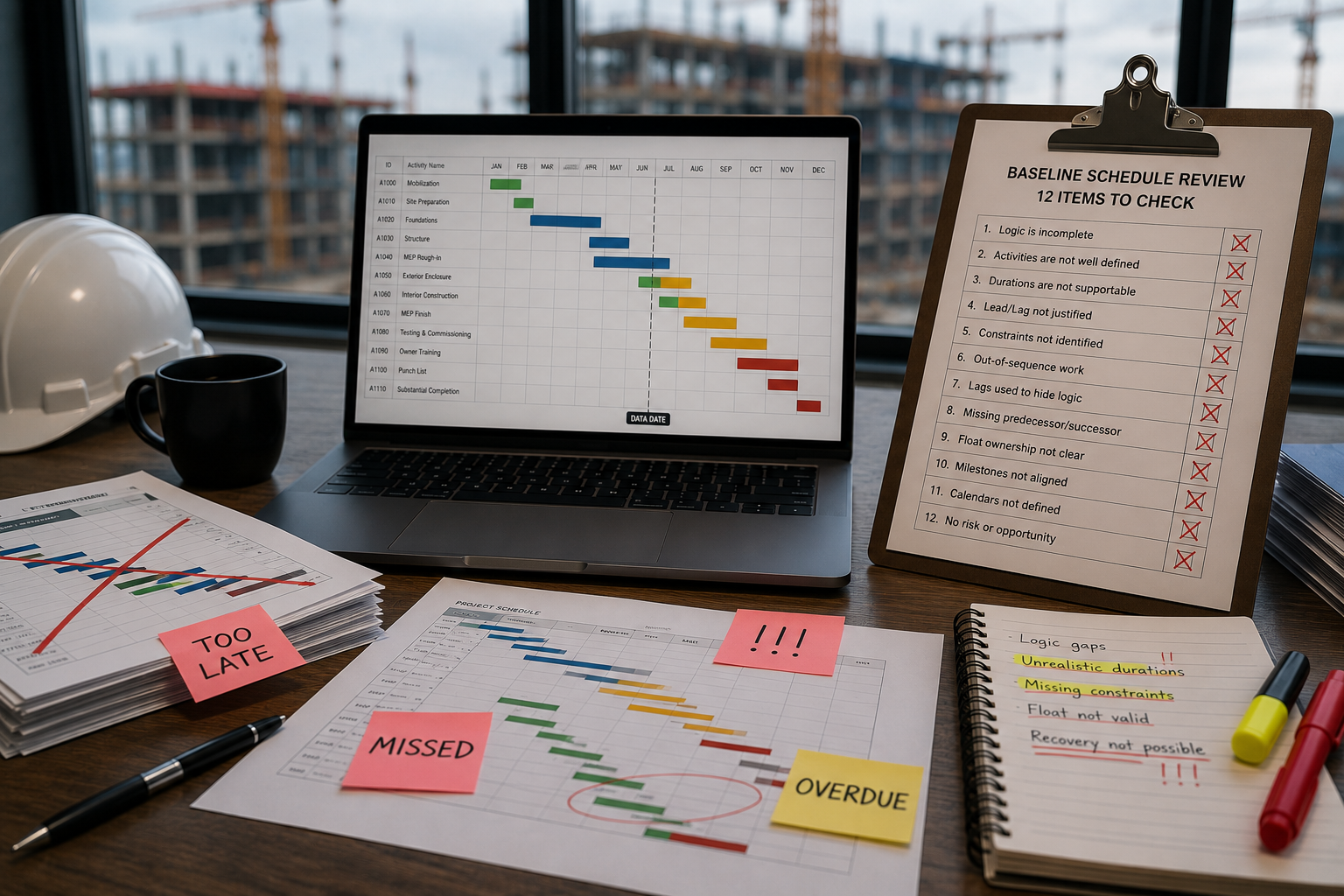
The pattern is consistent. Construction starts before design is complete, which is the point of fast-track. But the schedule is usually built as if design were complete, with finish-to-start logic across the full sequence and durations that assume clean handoffs. When design issues surface during construction, which they will, the schedule has no logical capacity to absorb them. Float gets consumed on activities that were never the right place for float to live. Re-baselining happens informally, without owner approval, because the scheduler is trying to keep the dates stable.
By the time someone notices, the schedule has been quietly rewritten three times and bears little resemblance to the contract baseline.
This is the area where a planning and scheduling engagement pays for itself fastest. CPM scheduling done with the right logic for fast-track conditions — start-to-start lags where they belong, finish-to-finish constraints on parallel paths, defensible reasons for every constraint, monthly logic checks, baseline change procedures that require written approval, looks unglamorous on paper. It also happens to be the only thing that holds the project together when design issues arrive on a compressed timeline.
The AACE International Recommended Practice 29R-03 covers the forensic standard. Owners who want their schedule to survive the project should look at it before the project starts, not after.
4. Risk that’s actually ranked
Most capital project risk registers are theater. A list of 40 risks, none ranked by exposure or probability, none with assigned owners, none with a trigger date. Nobody reads it. Nobody updates it. By month four, it’s a static document in a SharePoint folder.
The reason is that ranking risk is hard. It requires the team to commit, in writing, to which risks they actually believe will happen and how much they’ll cost. That commitment makes people uncomfortable, so the easiest path is to list everything and rank nothing.
A useful risk register has 8 to 12 active items, ranked by expected monetary impact, each with a named owner and a review cadence. Items get added when conditions warrant. Items get retired when they’re resolved or have passed. The register is reviewed in the monthly project meeting and the changes are documented.
This is genuinely an area where construction management consulting earns its keep. Not because the consultant identifies risks the team didn’t know about, but because the consultant maintains the discipline of keeping the register honest. The team usually knows the risks. They need someone whose job is to keep the list current.
Where consulting can’t help
The honest part.
Consulting can’t fix a project where the owner has under-budgeted by 25 percent and won’t acknowledge it. It can’t fix a project where the contract structure puts the GC and the owner on opposite sides of every decision. It can’t fix a design that wasn’t ready to be bid. And it can’t fix a project where the owner’s internal team doesn’t have decision-making authority and every issue has to escalate three levels before anything happens.
These are problems that consulting engagements get hired to solve and almost never do. Owners would do better to address them directly: revise the budget, restructure the contract, finish the design, empower the team. Hiring a consultant to manage around these problems usually just adds a layer of reporting on top of dysfunction that hasn’t been addressed.
The construction consulting work that delivers measurable efficiency on capital projects is narrower than the marketing usually suggests. It’s procurement strategy, reporting discipline, schedule integrity, and risk management. Done well, those four interventions move project outcomes by single-digit percentages on cost and double-digit percentages on schedule. That’s a real return on a real fee.
It’s also all the things consulting can do. The rest is up to the owner.
For owners managing capital programs in the DC-Baltimore corridor and across the Mid-Atlantic, Stelic provides owner-side construction management, project controls, and program management on complex projects in life sciences, data centers, federal infrastructure, and healthcare. The Construction Management Association of America maintains a useful overview of owner-side CM practice for teams evaluating the discipline for the first time.