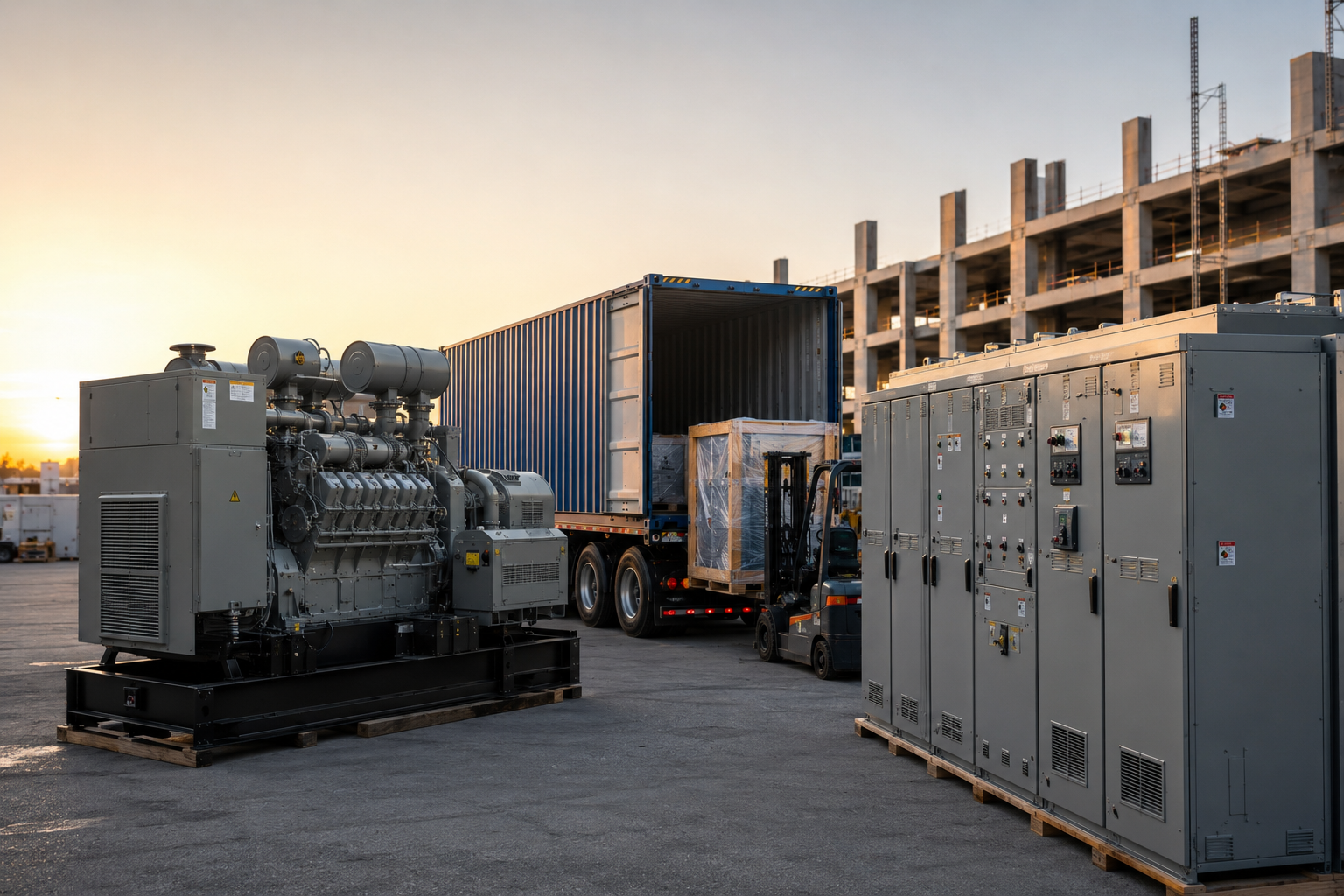
Generator and Switchgear Lead Times: What Owners Need to Know Before They Build the Schedule
A “generator delay” is almost never a manufacturing problem. It’s a submittal approval problem, a raw material sourcing problem, or a factory backlog problem that gets logged, months later, as an equipment delay. By the time the delay shows up on a delay log, the actual cause happened weeks or months earlier, further back in the chain than most schedules track.
Understanding what actually sits inside a generator or switchgear lead time is the difference between a schedule that survives a claim and one that doesn’t.
Current Lead Time Ranges by Equipment Type
Lead times shift with market demand, and data center construction volume has pushed most major electrical equipment categories well past pre-2022 norms. As of this writing, typical ranges look like this:
| Equipment | Typical lead time | Primary driver |
|---|---|---|
| Diesel generators (2 to 4 MW) | 18 to 30 months | Engine block casting capacity, turbocharger sourcing |
| Medium voltage switchgear | 12 to 24 months | Transformer core steel, breaker component sourcing |
| Low voltage switchgear | 8 to 16 months | Breaker and busway component availability |
| UPS systems (large scale) | 6 to 14 months | Battery cell sourcing, power module manufacturing |
| Medium voltage transformers | 18 to 36 months | Core steel and copper winding capacity |
| Automatic transfer switches | 6 to 12 months | Contactor sourcing, lower volume relative to switchgear |
These numbers move. What doesn’t move is the underlying lesson: the equipment categories with the longest lead times are also the ones with the least flexible manufacturing capacity, meaning they are the least forgiving of a late submittal.
Why “Equipment Delay” Is Usually a Procurement Delay Wearing a Different Name
The sequence that actually produces most equipment delays looks like this. A submittal gets returned with comments. The comment resolution takes three weeks longer than planned because the engineer of record is reviewing five other submittals from five other projects. The corrected submittal goes back into the manufacturer’s queue, but the manufacturer’s production slot has already moved to the next available opening, which might be four months out, not four weeks out.
None of that shows up as a submittal delay on most delay logs. It shows up as “generator delivery delayed,” attributed entirely to the manufacturer, with the actual root cause, the submittal cycle, invisible upstream.
This distinction matters for two reasons. First, it changes who owns the delay for contractual purposes. A late submittal approval is a different animal than a manufacturer production slip, and the responsible party is often different depending on who caused the resubmittal cycle. Second, and more practically, it changes what an owner can actually do about it. A production slot, once lost, usually cannot be recovered by expediting fees or escalation calls. A submittal cycle, if caught early, can be compressed with faster review turnaround.
Where the Real Schedule Risk Sits
Submittal approval turnaround. This is the highest leverage point in the entire procurement chain and the one owners have the most actual control over. A four week internal review standard, enforced consistently, protects more schedule than any amount of manufacturer expediting.
Production slot booking. Manufacturers book production capacity months or years in advance. A generator order placed the day a submittal is approved is not entering a queue that starts counting from zero. It is entering whatever slot is next available, which may already reflect the manufacturer’s existing backlog.
Component-level sourcing. Engine blocks, transformer core steel, and battery cells are frequently the actual constraint behind a stated lead time, not final assembly capacity. This is why two generators from the same manufacturer, ordered a few weeks apart, can have lead times that differ by months. It depends on which raw material batch each order lands in.
Factory acceptance testing scheduling. FAT slots are their own separate booking process, distinct from manufacturing completion. A generator that finishes assembly on schedule can still sit waiting for an available FAT slot, adding weeks that rarely appear in the original procurement schedule.
How to Build Procurement Into the Master Schedule Correctly
Long-lead electrical equipment should be treated as its own schedule fragnet, not folded into a generic “procurement” bar. That fragnet should show submittal issue, review, resubmittal if needed, purchase order release, production slot confirmation, FAT scheduling, FAT completion, shipping, and delivery to site, each as a discrete activity with its own float.
The submittal and resubmittal activities deserve the most schedule attention, because they are the only activities in the chain the owner’s team and design team actually control. Everything downstream of purchase order release is largely in the manufacturer’s hands.
Frequently Asked Questions
How long is the lead time for a data center generator? Diesel generators in the 2 to 4 megawatt range typically run 18 to 30 months from order to delivery as of current market conditions, driven primarily by engine block casting and turbocharger component availability rather than final assembly capacity.
Why do generator and switchgear lead times keep getting logged as delays when they were foreseeable? Most projects log the symptom, a late delivery, rather than the cause, which is frequently a late submittal approval that pushed the order past its intended production slot. The actual root cause typically occurred months before the delivery date and several steps upstream in the procurement chain.
Can expediting fees recover a lost production slot? Rarely, once a slot is lost. Manufacturers book production capacity based on component availability, not just labor capacity, so an expediting fee generally cannot manufacture raw material that does not yet exist. Expediting is more effective earlier in the process, particularly around submittal review turnaround, than after a purchase order has already missed its intended slot.
What is the highest leverage point owners have over equipment lead times? Submittal review turnaround time. It is the only stage in the procurement chain fully within the owner and design team’s control, and a slow review cycle is the most common hidden cause of what eventually gets recorded as a manufacturer delay.