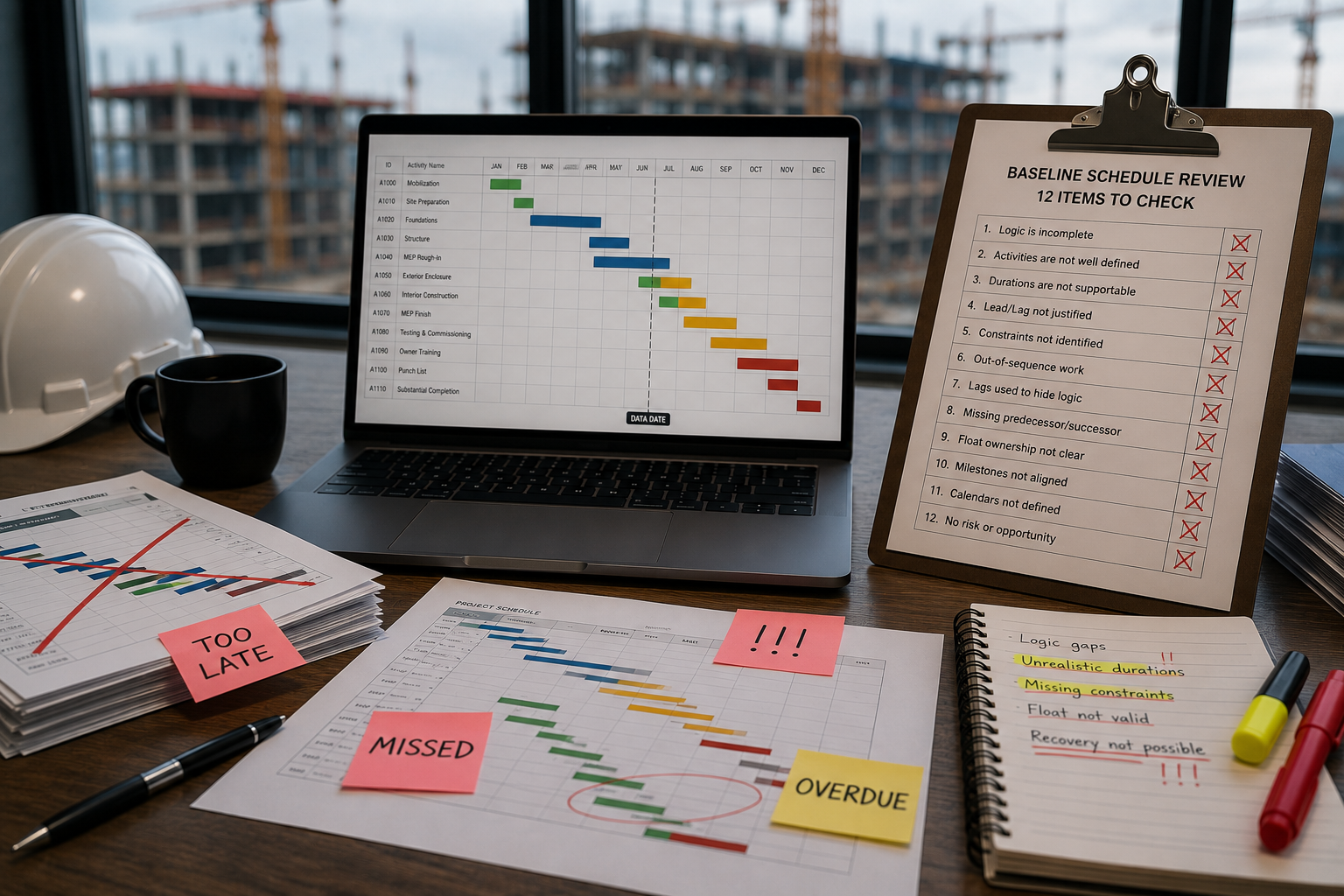
Why Data Center Pours Run 18 Hours Straight, and What It Exposes About Your Schedule Logic
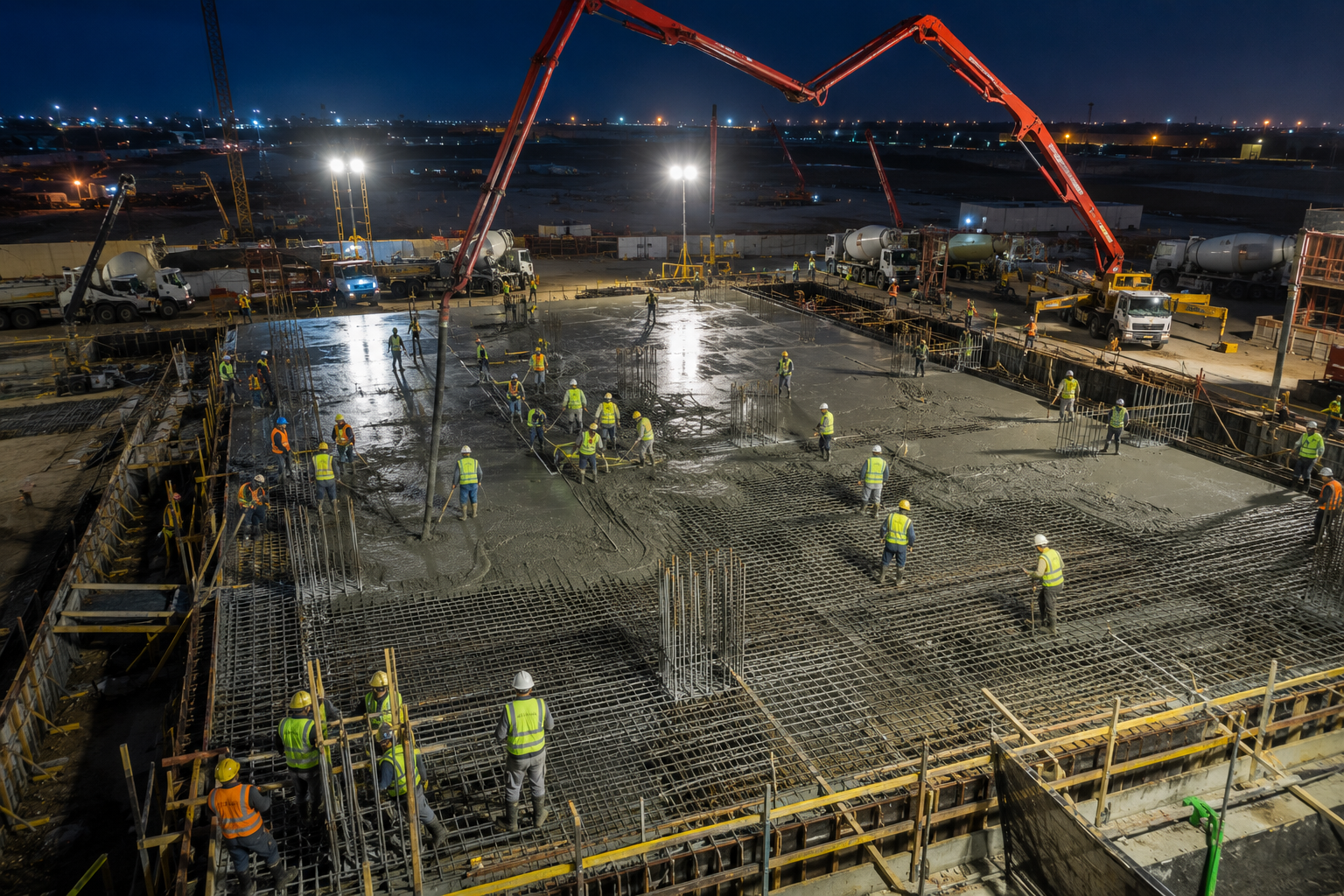
A data center slab pour that runs 18 hours is not a contractor showing off. It’s a decision made months earlier, buried in a mix design submittal and a concrete supplier’s batch plant capacity, that most owner-side teams never actually reviewed as a schedule risk.
Large equipment yards, generator pads, and structural slabs on hyperscale data center projects are frequently poured continuously, sometimes overnight, because a cold joint in the wrong place can compromise the structural performance the design calls for. The pour has to finish before the concrete’s initial set. That constraint doesn’t show up as a line item on most master schedules. It shows up as one bar labeled “concrete placement,” with a duration nobody questioned.
What an 18 Hour Pour Actually Requires
A continuous pour of that duration is really a coordination problem wearing a concrete costume. It requires a batch plant with enough capacity to keep trucks cycling for the full duration without a gap long enough to let a previous lift begin setting. It requires enough trucks in rotation, accounting for haul distance and traffic, to maintain that cycle. It requires a crew large enough to place, vibrate, and finish concrete for the full duration without a shift change creating a quality gap. And it requires a weather window, because a sudden temperature swing or a rain event mid-pour can force a decision nobody wants to make at 2 a.m.
None of those requirements are concrete requirements. They’re logistics requirements that happen to be triggered by a concrete mix design. A schedule that treats “concrete placement” as a single generic activity, the same duration formula used for a smaller footing pour, is missing the actual risk entirely.
Where This Exposes Weak CPM Logic
The tell is almost always in how the schedule ties the pour to what comes before and after it. If the activity immediately preceding the pour is “form and rebar complete” with no float, and the activity immediately following is “strip forms” scheduled the next calendar day with no allowance for cure time appropriate to the specific mix design and ambient conditions, the schedule was built by someone who has never stood next to a batch plant during a mass pour.
A schedule that respects what a large pour actually requires builds in float ahead of the pour date for weather contingency, ties the pour to a confirmed batch plant capacity commitment rather than an assumed one, and separates initial set, final set, and strip time as distinct durations rather than collapsing them into a single generic cure period. That level of specificity is the difference between a schedule that survives a rain delay and one that turns a rain delay into a claim.
The Pattern Shows Up Beyond Concrete
This is not really a story about concrete. It’s a story about how schedules handle any activity that has a hard physical constraint the schedule itself doesn’t understand. Continuous pours are just the most visible version of it, because the failure mode is dramatic and immediate. A cold joint in a critical structural element is not a delay. It’s a redesign conversation.
The same logic gap shows up in commissioning sequences that ignore load bank scheduling, in MEP rough-in sequences that ignore inspection hold points, and in procurement schedules that treat a manufacturer’s production slot as infinitely flexible. Any time a schedule activity is written with a generic duration formula instead of a duration derived from the actual physical or logistical constraint driving it, that activity is a liability waiting for the wrong week to show up.
What Owner-Side Teams Should Actually Ask
Before a mass pour date gets locked into the master schedule, an owner-side controls team should be able to answer three questions with specifics, not assumptions. What is the confirmed batch plant output capacity, in cubic yards per hour, and does that match the volume required to finish within the mix design’s working window? What is the weather contingency plan, and does the schedule show float ahead of the pour date to absorb a delay without cascading into the next trade sequence? And what are the actual cure and strip times for this specific mix design and this specific ambient temperature range, not a generic three day placeholder pulled from a template.
If those answers come back vague, the pour date on the schedule is a placeholder, not a plan. And a placeholder that fails at 2 a.m. with a live batch plant running is a much more expensive problem than the same gap caught in a schedule review three weeks earlier.