Clean Room Classification Dictates Sequencing, Not Just Design
ISO classification gets specified early in a pharmaceutical project and then, too often, treated as a design detail that construction will simply deliver on. That’s backward. The classification level a space needs to achieve determines the order construction has to happen in, which trades go first, how long the space has to run before it can be tested, and what happens to the schedule if a test fails. Treating classification as a design spec rather than a sequencing driver is one of the most common reasons clean room construction schedules slip.
The Classification Framework, in Plain Terms
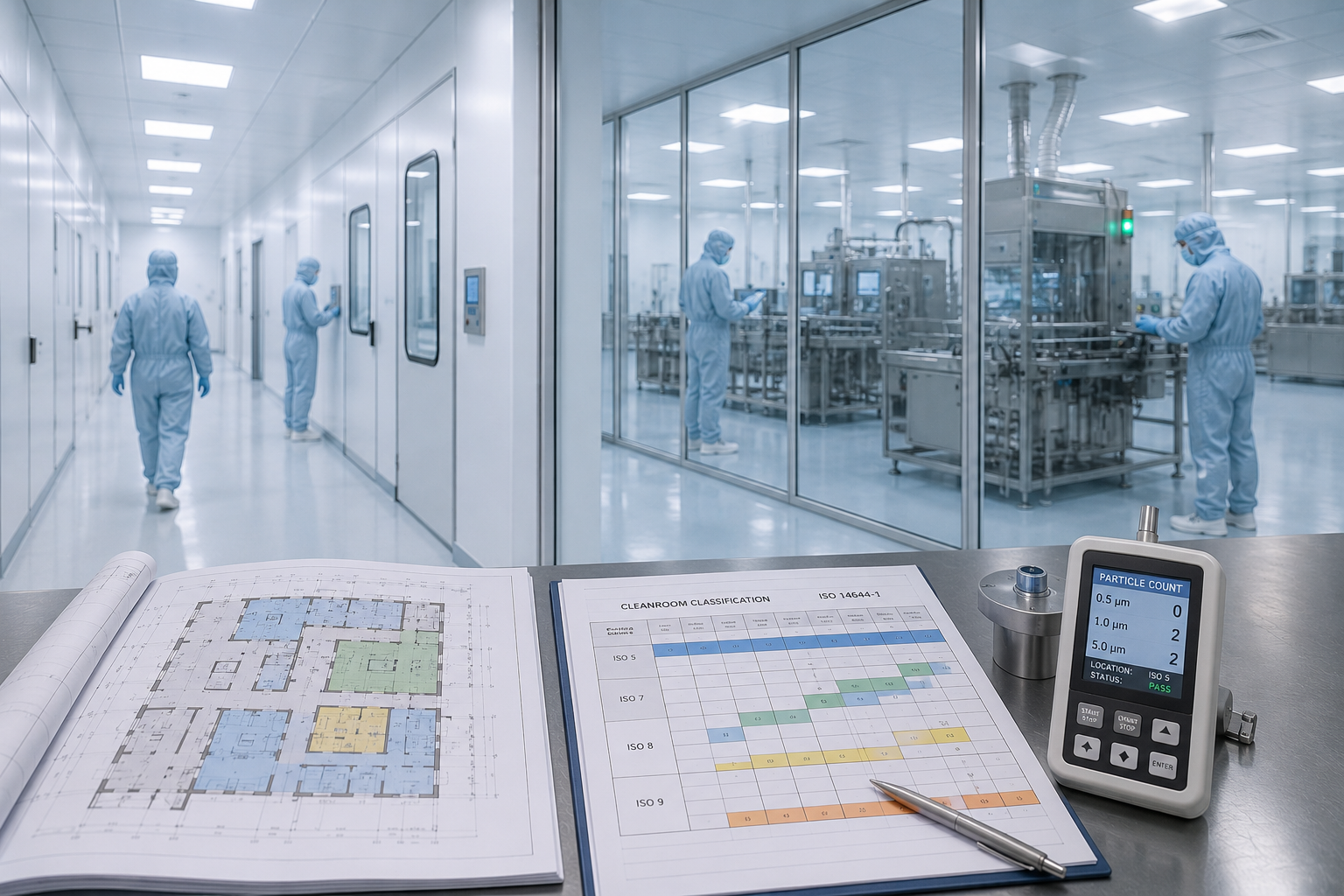
ISO 14644-1 defines cleanliness classes based on particle count per cubic meter of air, ranging from ISO Class 1, the cleanest, to ISO Class 9. Pharmaceutical manufacturing typically operates in the ISO 5 through ISO 8 range, and EU GMP Annex 1 maps a parallel Grade A through D system that’s commonly used alongside or instead of the ISO designations in pharma-specific contexts.
| ISO Class | Approximate GMP Grade | Typical use |
|---|---|---|
| ISO 5 | Grade A (at rest and in operation) | Aseptic filling, critical processing zones |
| ISO 5 (at rest) / ISO 7 (in operation) | Grade B | Background environment for Grade A activities |
| ISO 7 | Grade C | Less critical processing steps |
| ISO 8 | Grade D | Support areas, gowning, less critical manufacturing |
The distinction between “at rest” and “in operation” matters more for scheduling than most owners realize. A space has to be tested and classified in both states, and a space that passes at-rest testing can still fail in-operation testing once personnel and equipment are actually working inside it. That’s a second classification test, not a formality, and it has to be scheduled as its own activity with its own potential for failure and retest.
Why the Classification Level Determines Construction Order
Higher classification spaces need to be built last, not designed last. A Grade A or ISO 5 space is the most contamination-sensitive area in the facility, which means it should receive its finishes, its final HVAC balancing, and its terminal cleaning last, after the surrounding lower-classification spaces are substantially complete and generating less construction dust and particulate. A schedule that builds all spaces in the same general sequence, driven by floor plan adjacency rather than classification level, risks contaminating a finished Grade A space with construction activity happening in an adjacent Grade C space that wasn’t sequenced to finish first.
HVAC commissioning has to precede classification testing, and classification testing has to precede equipment installation in some cases. The HVAC system serving a classified space has to be balanced and proven before the space can be tested for particle count, because air changes per hour and pressure differentials between adjacent spaces are central to maintaining classification. Some equipment installation activities, particularly anything that could introduce contamination risk, may need to wait until after initial classification testing confirms the space and its air handling are performing correctly.
Gowning and access protocols change construction logistics, not just operational logistics. Once a space achieves even interim classification during construction, and many projects use interim gowning and access protocols during later construction phases specifically to protect classification progress, trade access has to follow the same discipline that operational staff will eventually follow. That changes crew scheduling, material staging, and how many trades can realistically work in a classified area at once.
What Happens When Sequencing Gets This Wrong
The most common failure pattern looks like this. Construction proceeds broadly on schedule, with trades sequenced by floor plan logic rather than classification sensitivity. Final cleaning and HVAC balancing happen, classification testing is scheduled, and the space fails, usually due to particulate introduced by finishing work happening in an adjacent space that wasn’t sequenced to complete earlier. The retest, along with whatever remediation cleaning is required, adds weeks that a classification-aware sequence would have avoided entirely.
Building the Schedule Around Classification, Not Around Floor Plan
The construction sequence should be organized by classification level first, floor plan adjacency second. Higher classification spaces get scheduled to receive final finishes and HVAC balancing after lower classification spaces are complete enough to no longer generate meaningful particulate. Classification testing itself should appear as a discrete milestone with realistic float for a potential failed test and retest, not as an assumed pass folded into the closeout period.
Frequently Asked Questions
What’s the difference between ISO classification and GMP grade for clean rooms? ISO 14644-1 classifies cleanliness based on particle count per cubic meter of air, from ISO Class 1 through 9. EU GMP Annex 1 uses a parallel Grade A through D system commonly applied in pharmaceutical contexts, with Grade A roughly corresponding to ISO 5 and Grade D roughly corresponding to ISO 8, though the two systems are not perfectly interchangeable in every regulatory context.
Why does clean room construction need to be sequenced by classification level? Higher classification spaces are more sensitive to contamination from ongoing construction activity, so they need to receive final finishes, HVAC balancing, and terminal cleaning after adjacent lower classification spaces are substantially complete. Sequencing by floor plan adjacency instead of classification sensitivity risks contaminating a finished high-classification space with particulate from nearby ongoing construction.
What is at-rest versus in-operation classification testing? A clean room must be tested and classified in both states. At-rest testing occurs with no personnel or operating equipment present. In-operation testing occurs with personnel and equipment actively working in the space, and a space that passes at-rest testing can still fail in-operation testing, making it a separate scheduled activity with its own risk of requiring a retest.
How should classification testing be reflected in the construction schedule? As a discrete milestone with realistic float built in for a potential failed test and remediation cleaning, rather than an assumed pass folded into general closeout activities. HVAC commissioning and balancing should be scheduled as an explicit predecessor to classification testing, since air changes and pressure differentials are central to whether a space achieves and maintains its target classification.