Flagging and Outage Windows: The Constraint That Makes Transportation Schedules Unlike Anything Else
Most construction access constraints are project-specific. A single contractor, on a single site, negotiating its own access with its own owner. Flagging operations and track outage windows on transportation projects don’t work that way. They’re frequently a shared, scarce resource, allocated across multiple contractors and sometimes multiple projects competing for the same limited access, and that shared scarcity changes the entire logic of how these constraints belong in a schedule.
What Flagging and Outage Windows Actually Are
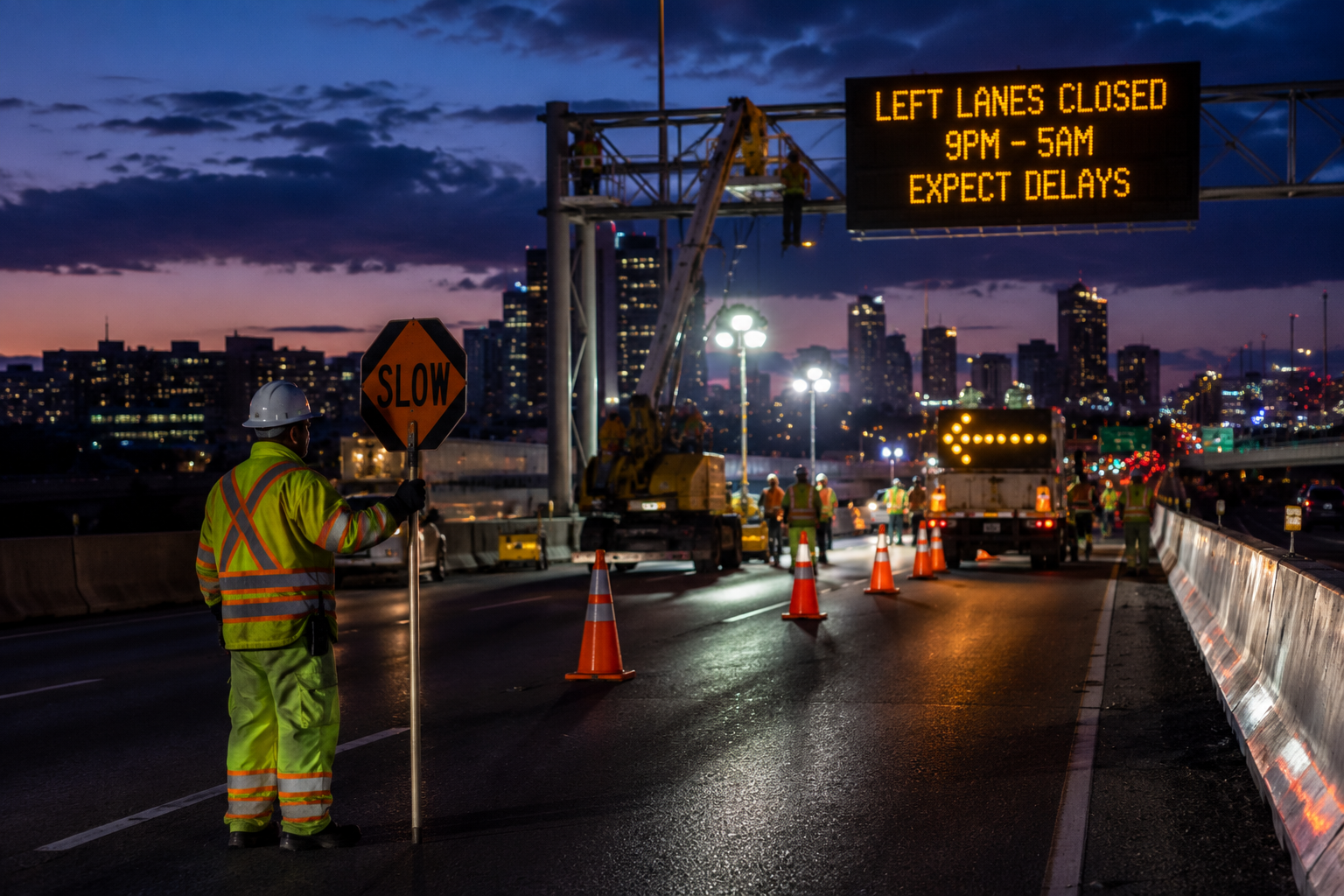
A flagging operation, common on roadway work near active travel lanes and on any construction adjacent to active rail, provides temporary traffic or train control to allow safe worker access to a work zone, typically requiring a certified flagger or, for rail, a qualified train control employee, and often requiring advance scheduling and coordination with the operating agency.
A track outage window is a defined period during which a section of active rail track is taken out of service, allowing contractors to work on or adjacent to the track without live train traffic. Depending on the corridor, this might mean single-tracking, running all traffic on a remaining track while the other is under outage, or a full closure during off-peak hours or weekends when service can be reduced or suspended entirely.
Why These Constraints Behave Differently Than Typical Site Access
The resource is shared, not exclusive to one project. On an active rail corridor or a heavily trafficked roadway, outage windows and flagging capacity are frequently allocated across multiple projects and multiple contractors working in the same corridor or on the same system, all competing for a limited number of available windows, especially where nighttime or weekend outages are the only option that doesn’t disrupt live service.
The operating agency, not the contractor, usually controls allocation. Unlike a typical construction schedule where the contractor sequences its own work within a fixed overall duration, flagging and outage windows are frequently allocated by the transit or transportation agency itself, based on agency priorities, coordination with other projects in the same corridor, and operational requirements that have nothing to do with any single contractor’s schedule preferences.
Windows are often committed well in advance and difficult to change once locked. Because outage windows require advance coordination with train operations, other maintenance activities, and sometimes public notice requirements for service changes, a window secured for a specific date is often not something a contractor can simply move if their own schedule shifts. A contractor that isn’t ready when their allocated window arrives may not get another one for weeks or months, not because the constraint is inherently as rigid as it sounds, but because the coordination overhead to reschedule competes with every other project also trying to get windows on the same corridor.
A missed or underutilized window represents a real, difficult-to-recover cost, similar in kind to a missed shutdown window in water infrastructure. Work planned for an outage window that isn’t completed within that window either has to wait for the next available window or requires an emergency request that may or may not be granted, given competing demand from other projects on the same system.
What Belongs in the Schedule
Every activity dependent on a flagging operation or an outage window should be scheduled with that specific window as a hard constraint, not a target duration assumed available on demand. The schedule should reflect the actual process and lead time required to request and confirm a window with the operating agency, which is frequently measured in weeks or months, not days. And where a project depends on a sequence of multiple outage windows, the schedule should show the cumulative risk of any single window in that sequence slipping or being reallocated, rather than treating each window in isolation as independently low risk.
Frequently Asked Questions
What’s the difference between a flagging operation and a track outage window? A flagging operation provides temporary traffic or train control using a certified flagger or qualified train control employee to allow safe worker access near active travel lanes or rail traffic. A track outage window is a defined period when a section of track is taken fully out of service, sometimes through single-tracking and sometimes through a full closure, allowing work without live train traffic present.
Why are outage windows harder to reschedule than typical construction delays? Because they require advance coordination with train operations, other maintenance activities on the same corridor, and sometimes public notice requirements, and they’re often shared across multiple projects competing for limited available windows. Rescheduling isn’t just a contractor decision, it requires re-securing a slot against that same competing demand.
Who typically controls allocation of flagging and outage windows? The operating transit or transportation agency, based on its own operational priorities and coordination needs across potentially multiple projects in the same corridor, rather than the contractor performing the work needing the access.
How should outage window dependency be reflected in a construction schedule? As a hard constraint tied to a specific confirmed window, with realistic lead time built in for the request and confirmation process, and with cumulative risk modeled explicitly when a project depends on a sequence of multiple windows rather than treating each one as independently reliable.