Long-Lead Procurement in Water Infrastructure: Pumps, Valves, and the 40-Week Reality
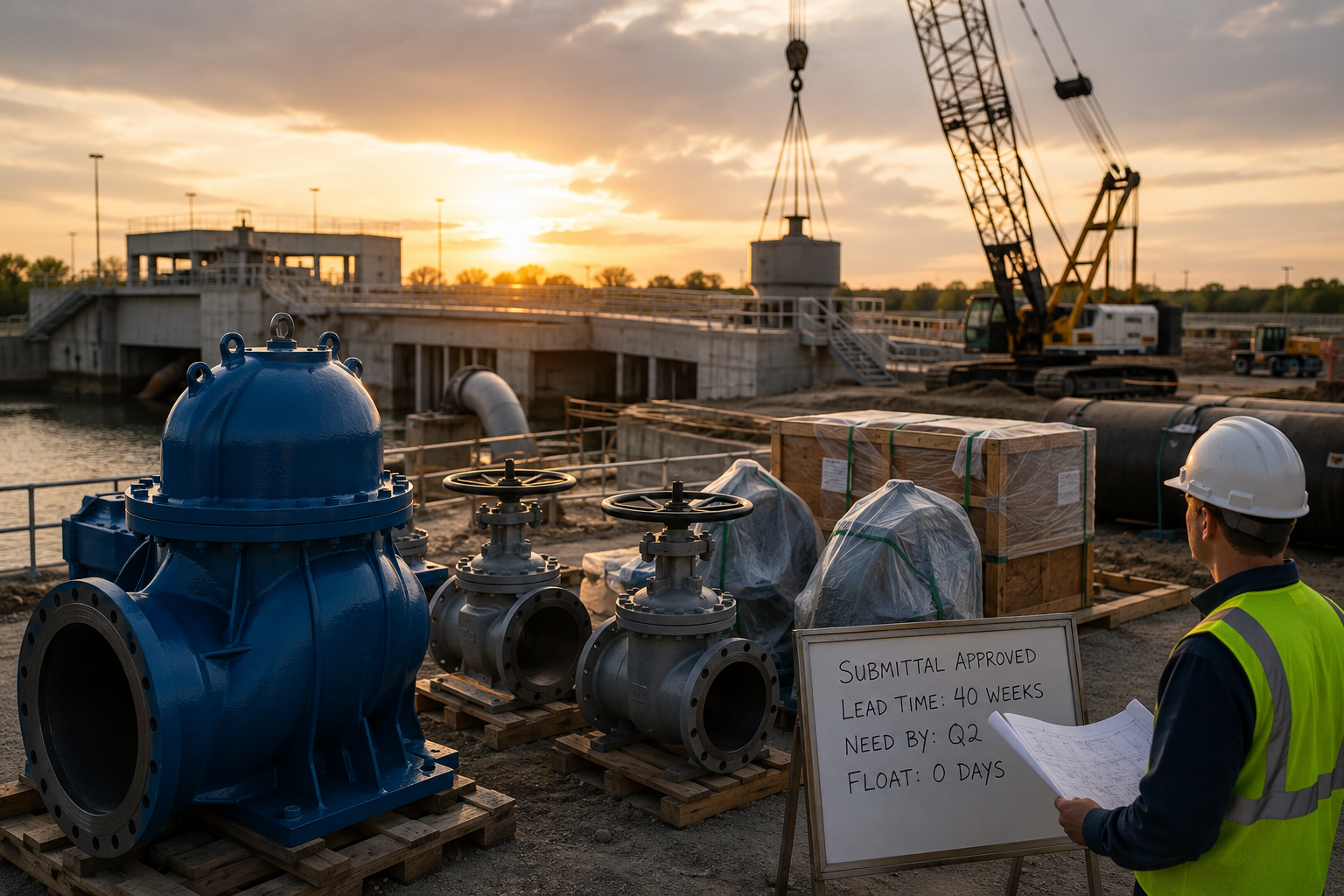
A lot of water and wastewater infrastructure schedules are still built around procurement durations that stopped being accurate several years ago. Large diameter valves, major pumps, and the motors and drives that go with them routinely run 40 weeks or more from order placement to delivery, and a schedule that assumes a 16 to 20 week procurement window because that’s what a template says is building in a delay before construction has even started.
Current Lead Time Reality by Equipment Category
Lead times shift with raw material and component availability, and water infrastructure equipment has been affected by the same supply chain pressure that’s reshaped procurement across heavy industrial construction generally. As of this writing, typical ranges for major equipment categories look like this.
| Equipment | Typical lead time | Primary driver |
|---|---|---|
| Large diameter butterfly and gate valves | 30 to 52 weeks | Casting capacity, actuator sourcing |
| Vertical turbine and large centrifugal pumps | 30 to 50 weeks | Motor sourcing, casting and machining capacity |
| Variable frequency drives | 20 to 40 weeks | Semiconductor and power module component availability |
| Large motors (above 200 hp) | 26 to 44 weeks | Copper winding and core steel sourcing |
| Chemical feed systems | 16 to 28 weeks | Lower complexity, but still subject to component sourcing |
| Membrane filtration units | 24 to 40 weeks | Specialized manufacturing capacity, limited supplier base |
The pattern across nearly every category is the same one seen in other heavy equipment sectors. The limiting factor is rarely final assembly. It’s upstream component sourcing, casting capacity, motor windings, semiconductor components for drives, that manufacturers don’t fully control either, which is part of why these durations have proven sticky rather than reverting to pre-2020 norms.
Why This Matters More on Water Infrastructure Than Commercial Construction
Water and wastewater projects have less schedule flexibility to absorb a procurement surprise than a lot of commercial construction, for a structural reason. Much of the work happens around an operating facility that can’t simply pause service while equipment arrives late. A treatment plant upgrade with a tie-in planned around a specific shutdown window, discussed in more detail in our related piece on shutdown constraints, can’t simply push that shutdown to whenever the pump eventually shows up. Shutdown windows are their own scarce resource, and a procurement delay that misses one can mean waiting for the next available window, which might be months away, not weeks.
Where Schedules Most Commonly Get This Wrong
Templates and historical durations don’t get updated project to project. A scheduling team that built a similar plant five years ago, using procurement durations accurate at the time, sometimes reuses that template without re-verifying current lead times against the specific manufacturers being considered for this project. Five years of supply chain change doesn’t show up in a template that wasn’t rebuilt from scratch.
Procurement timing gets started at notice to proceed instead of at design development. Given lead times of 40 weeks or more, and given that many major equipment specifications can be substantially finalized well before final design completion, there’s real schedule value in initiating vendor engagement and even early procurement commitments during design development rather than waiting for full notice to proceed. Waiting the standard amount of time to start ordering, when the standard amount of time no longer reflects reality, manufactures a delay that didn’t need to happen.
Multiple long-lead items aren’t sequenced against each other for combined risk. A project ordering a large pump, a set of large valves, and a set of VFDs simultaneously is exposed to the combined risk that any one of those items slips, not just the average risk of a single item. A schedule that shows each item’s expected duration without accounting for the realistic chance that at least one of several long-lead items will run past its stated lead time is understating the project’s true procurement risk.
What Should Change in How These Schedules Get Built
Procurement durations for major water infrastructure equipment should be verified against current market data for the specific project’s timeframe and specific manufacturers under consideration, not carried forward from a prior project’s schedule. Vendor engagement should start as early as design maturity allows, potentially well before traditional notice to proceed, given how much schedule value is at stake. And where a project depends on a specific shutdown window for tie-in work, the procurement schedule for equipment required at that tie-in should carry enough float to protect the shutdown date, or the shutdown date itself should be planned around confirmed delivery commitments rather than assumed lead times.
Frequently Asked Questions
How long is the current lead time for large water treatment pumps and valves? Large diameter valves and major pumps commonly run 30 to 52 weeks from order to delivery as of current market conditions, driven primarily by casting capacity and motor sourcing rather than final assembly time.
Why do water infrastructure projects need longer procurement float than typical commercial construction? Because tie-in work often depends on a scarce shutdown window at an operating facility that can’t simply pause service. A procurement delay that causes a project to miss a scheduled shutdown window can mean waiting months for the next available window, rather than absorbing the delay linearly the way a commercial project might.
Should equipment procurement start before final design completion on water infrastructure projects? Given lead times frequently exceeding 40 weeks, there’s real schedule value in initiating vendor engagement and early procurement commitments once major equipment specifications are substantially finalized during design development, rather than waiting for traditional notice to proceed.
What’s the risk of ordering multiple long-lead items on the same project? The combined risk that at least one item slips past its stated lead time is higher than the risk of any single item slipping in isolation. Schedules that show each long-lead item’s expected duration independently, without accounting for this combined exposure, tend to understate the project’s true procurement risk.