Phased Occupancy in Active Hospitals: The CPM Logic Nobody Teaches
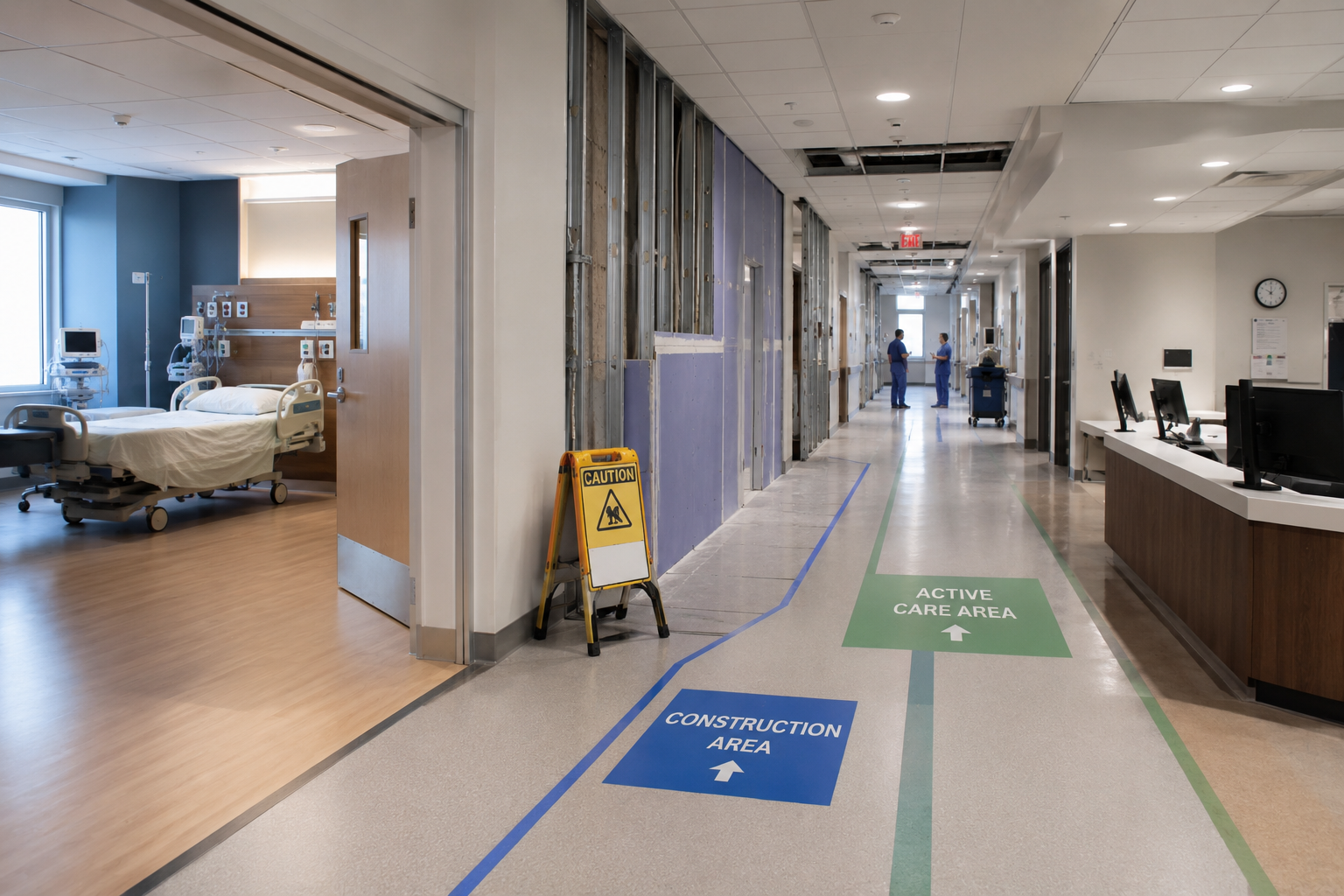
Most CPM training assumes a building that isn’t occupied yet. Design, then construct, then commission, then open. A phased renovation inside an active hospital breaks that assumption at the root, because the building is already open, already treating patients, and the schedule has to move construction activity around the hospital’s operational reality instead of the other way around. That’s not a smaller version of new construction scheduling. It’s a genuinely different logic, and most schedulers trained on ground-up projects have never actually had to build it.
Why the Predecessor Logic Runs Backward
On a new building, predecessor logic generally runs forward. Foundation before structure, structure before enclosure, enclosure before finishes. Each activity depends on the physical completion of the one before it.
In a phased, occupied hospital renovation, a lot of the real predecessor logic runs the other direction, driven by what has to be true about patient safety and operational continuity before construction can even start in a given zone. Before a nursing unit can be taken offline for renovation, the patients on that unit have to be relocated to swing space, which means the swing space has to be ready and operational first. Before a department can close for construction, replacement clinical capacity, whether that’s a temporary modular unit, a phased opening of a partially complete new wing, or absorbed capacity elsewhere in the facility, has to already exist and be functioning.
That means the true critical path in a phased hospital project often isn’t the construction activity itself. It’s the sequence of operational readiness milestones, swing space activation, equipment relocation, staff reorientation to a temporary workflow, that have to happen before construction can even begin in the next phase. A schedule that shows construction activities as the driving logic, with operational transitions as a side note, has the actual critical path backward.
What This Does to Phase Boundaries
Every phase boundary in this type of project is really two separate milestones layered on top of each other. There’s the construction milestone, when the physical work in a given zone is actually complete, and there’s the operational milestone, when the hospital can actually safely and functionally transition patients, staff, and equipment into or out of that zone. Those two milestones are not the same date, and treating them as interchangeable is where a lot of phased schedules quietly go wrong.
Construction can be substantially complete in a zone while the operational transition still requires final life safety inspection, ICRA containment teardown and verification, staff training on new layouts and equipment locations, and a defined patient transition window that hospital operations, not the construction team, actually controls. A schedule that shows “construction complete” as functionally equivalent to “unit reopened” is missing a real and often lengthy gap between the two.
Why This Requires a Different Kind of Schedule Owner
Building this logic correctly requires someone who understands both CPM mechanics and hospital operations well enough to translate operational requirements into real schedule constraints, not just construction milestones. That’s a different skill set than pure construction scheduling, and it’s also different from pure hospital operations planning. It sits in the overlap, and that overlap is exactly where owner-side project controls should be adding the most value on this type of project, not deferring entirely to either the construction schedule or the hospital’s internal operations team working in isolation from each other.
The hospital projects that actually hit their phase transition dates aren’t the ones with the tightest construction schedule. They’re the ones where someone built the operational readiness milestones into the CPM logic as real predecessors, with real float, instead of treating patient transitions as an assumption that would simply happen once construction finished.