Power Availability Is the New Critical Path on Data Center Construction Schedules
Three years ago, the long pole in a data center schedule was the building. Shell, structure, mechanical rough in, then a race to close the building before the equipment showed up.
That’s not the constraint anymore.
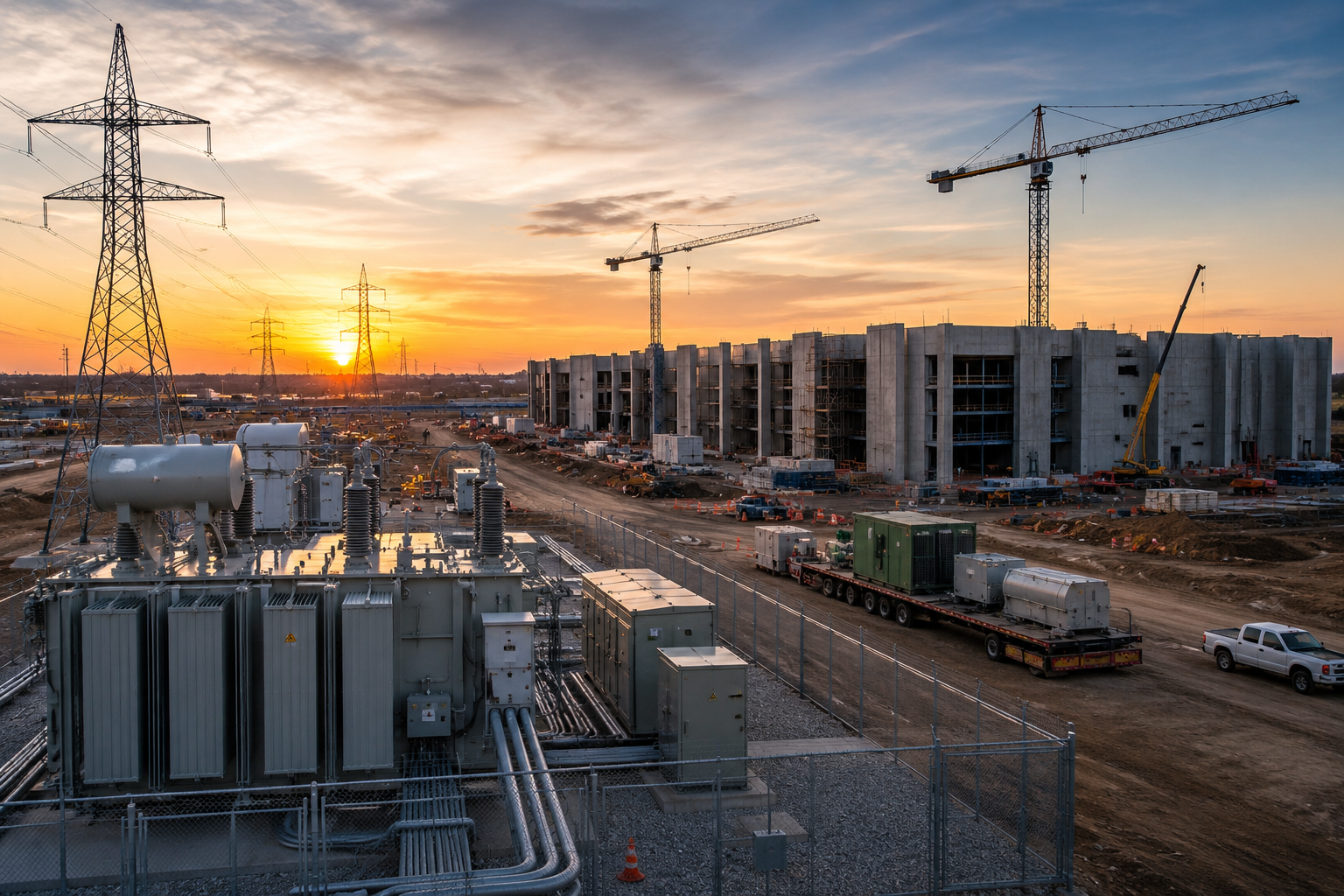
The constraint is the utility. Substation capacity, transmission upgrades, and interconnection queue position now determine when a data center can actually energize, and that timeline usually has nothing to do with how fast the general contractor can pour slab. Owners who build their schedule around construction milestones and treat utility interconnection as a parallel workstream are building the wrong schedule.
Why Utility Interconnection Now Drives the Critical Path
Utility interconnection studies, transmission upgrades, and substation buildouts routinely run 24 to 48 months in high demand markets like Northern Virginia, Central Ohio, and Phoenix. Construction of the building itself, by comparison, is often an 18 to 24 month effort once permits are in hand.
That gap matters. If the utility path is longer than the construction path, and it usually is now, the utility becomes the true critical path activity. Every other schedule decision, from equipment procurement to commissioning sequencing, should be built backward from the substantiated interconnection date, not from a design completion date or a groundbreaking date.
Most owner teams still schedule the opposite way. They set a groundbreaking date, work forward through construction logic, and treat the utility interconnection as an external dependency to be tracked on the side. That’s the error. The utility application should be filed before design development is even finished, because the interconnection queue does not wait for architectural sign off.
What Actually Sits Inside the Utility Timeline
The phrase “waiting on the utility” hides a lot of separate activities, and each one has its own duration and its own risk of slipping:
| Activity | Typical duration | Owner leverage |
|---|---|---|
| System impact study | 6 to 12 months | Low. Utility controlled. |
| Facilities study | 3 to 9 months | Low. Utility controlled. |
| Transmission or substation upgrade construction | 18 to 36 months | Low. Utility controlled, though co-funding can accelerate in some territories. |
| Interconnection agreement execution | 1 to 3 months | Medium. Legal and commercial negotiation. |
| Meter and protective relay commissioning | 1 to 2 months | Medium. Owner-side coordination. |
| Utility final energization | Fixed date once above is complete | Low. |
The line items owners actually control, the interconnection agreement and the final commissioning coordination, are the smallest slivers of the total timeline. That is exactly why they get neglected. Teams focus effort where they have the most control and the least schedule risk, and let the biggest risk item run on autopilot because it feels like someone else’s problem.
It is someone else’s problem, until it becomes the owner’s problem, at the exact moment the building is ready to energize and the utility isn’t.
How This Changes the Rest of the Schedule
Once power availability is confirmed as the long pole, every downstream milestone should be scheduled as a function of that date, not the other way around.
Equipment procurement. Generators, switchgear, and UPS systems have their own multi-quarter lead times, covered in more detail below. If those lead times are shorter than the utility timeline, and they usually are, procurement should be timed to land just ahead of the confirmed energization window, not as early as possible. Ordering switchgear two years before the substation is ready just parks capital and inventory risk on site with nowhere productive to go.
Commissioning sequencing. Integrated systems testing under load requires utility power. A commissioning plan that assumes generator backed testing can proceed independently of the utility date is only partially correct. Full load bank testing at scale, the kind that actually proves out the electrical infrastructure, often needs the permanent utility feed.
Contractor mobilization. If the building will sit substantially complete for six months waiting on power, that changes the labor curve, the retainage schedule, and the punch list strategy. It is cheaper to slow the construction curve deliberately than to finish early and then pay to maintain an empty, unenergized building.
The Owner-Side Move: File the Interconnection Request Before You Think You’re Ready
The single highest leverage move an owner has is filing the interconnection request earlier than feels natural, often before the design is fully locked. Queue position in most utility territories is date stamped, not merit based. A project that files six months later than a competing project in the same substation service area can lose real schedule time, independent of design quality or project readiness.
This means the owner-side project controls function needs a line item for utility interconnection status in the master schedule from day one, tracked with the same rigor as a long-lead equipment package. Not as a footnote. As the pacing item.
The projects that get burned aren’t the ones with bad general contractors. They’re the ones where nobody owned the utility relationship as a schedule deliverable, and by the time someone noticed, the queue position was already lost.
Frequently Asked Questions
How long does data center utility interconnection typically take? In high demand markets, the full path from system impact study through final energization commonly runs 24 to 48 months, depending on whether transmission or substation upgrades are required. Facilities studies and interconnection agreements add additional time on top of any required infrastructure construction.
Why is utility interconnection now longer than data center construction itself? Demand for grid capacity has outpaced utility infrastructure buildout in most major data center markets. Building a data center shell and core, once design and permitting are complete, is a more predictable and often shorter process than securing and building out the transmission or substation capacity to serve it.
What can an owner do to reduce utility interconnection delay risk? File the interconnection request as early as possible, often before design development is finalized, since most utility queues are date stamped by filing order. Owners can also explore co-funding transmission or substation upgrades in some utility territories to accelerate construction timelines, and should track interconnection status inside the master project schedule rather than as an external dependency.
Should construction procurement be timed to the utility date or started as early as possible? Procurement for major electrical equipment should be timed to land ahead of the confirmed utility energization date, not started as early as physically possible. Ordering critical equipment years ahead of an energization date that is itself years away creates unnecessary inventory and capital exposure without shortening the actual project timeline.