The IQ to OQ to PQ Handoff Is Where Owner-Side Visibility Usually Disappears
Most owner-side project controls teams have solid visibility into construction. Percent complete, RFI logs, submittal status, cost curves, all reasonably well tracked. That visibility tends to hold through Installation Qualification, because IQ is close enough to construction completion that the same team, the same reporting cadence, and the same tools still apply.
Then Operational Qualification starts, and for a lot of owners, the reporting quality drops off a cliff. Not because the work stopped being tracked. Because it moved into a different team’s hands, a different documentation system, and a different reporting rhythm that the owner-side controls function was never actually built to monitor.
Why the Handoff Creates a Visibility Gap
IQ confirms equipment is installed correctly, according to the manufacturer’s specifications and the approved design. It’s close enough to construction that the general contractor, the commissioning agent, and the owner’s construction team are all still actively engaged, and the reporting cadence that tracked construction progress can extend naturally to cover IQ status.
OQ confirms the equipment operates correctly across its intended operating range, and PQ confirms the equipment performs consistently under actual production conditions over a defined period. Both of these activities typically shift primary ownership to the validation team, often a different group entirely from the construction and commissioning team, sometimes a specialized quality or validation function within the owner’s organization, sometimes an outside validation consultant.
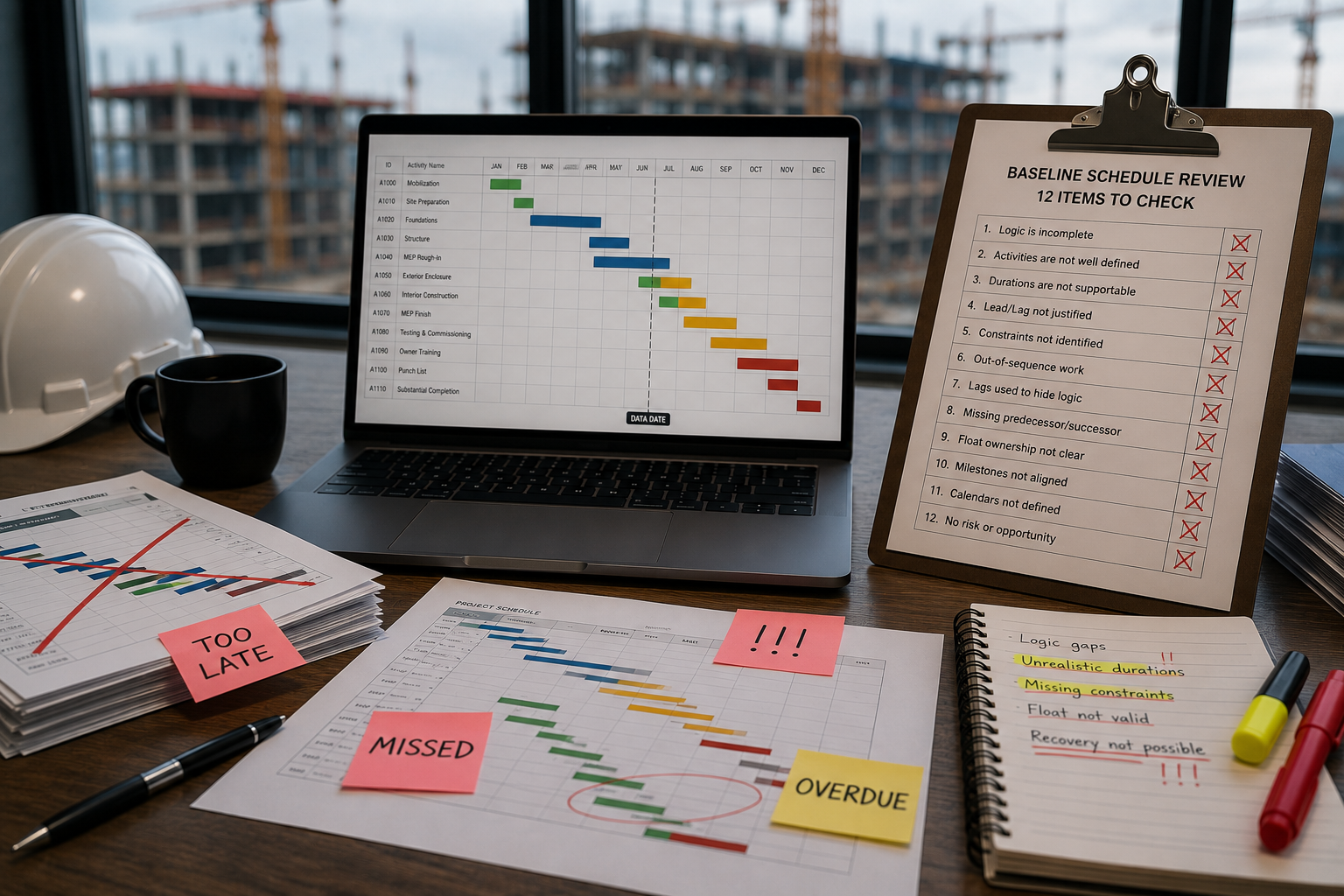
That shift in ownership is where the schedule visibility gap opens. The construction schedule, the one the owner-side project controls team has been managing all along, usually shows OQ and PQ as summary bars, “OQ” and “PQ,” each a few weeks long, without the granularity that construction activities get. Meanwhile, the actual work underneath those bars, individual test scripts, deviation investigations, retest cycles, is being tracked in a validation-specific system, often a quality management system the construction-side controls team doesn’t have access to or visibility into.
What Gets Lost Specifically
Deviation status becomes invisible. A deviation discovered during OQ testing triggers an investigation, a root cause analysis, and a corrective action, each with its own duration. On the construction schedule, this typically doesn’t show up as a change to the OQ bar’s duration until the delay has already happened. The owner-side team managing the master schedule often doesn’t know a deviation is in progress until someone tells them, well after it started affecting the timeline.
Retest cycles aren’t modeled as risk, they’re discovered as fact. A test script that fails and requires a retest adds a specific, often predictable duration, but only if someone is tracking test execution at that level of detail. Most master schedules don’t have that granularity for OQ and PQ, which means a retest shows up as a surprise schedule slip rather than a modeled risk that was always statistically likely given the number of test scripts involved.
PQ duration is often treated as fixed when it’s actually conditional. Performance qualification frequently requires a defined number of consecutive successful production runs or cycles. If a run fails partway through, the clock on consecutive successful runs often resets, which can meaningfully extend PQ duration in a way that a fixed calendar duration on the master schedule doesn’t capture at all.
What Owner-Side Controls Should Actually Do About It
The fix isn’t for construction-side project controls to try to become validation experts. It’s to build an explicit reporting bridge between the two functions before the handoff happens, not after visibility has already been lost.
That means negotiating, early, what level of detail the validation team will report into the master schedule during OQ and PQ, ideally including deviation counts and status, test script pass rates, and any conditional logic that could extend duration, like the consecutive successful run requirement in PQ. It means treating the OQ and PQ bars on the master schedule as placeholders that need a defined update cadence from the validation team, not static durations set once and left alone. And it means the owner-side controls function should ask, explicitly, at project kickoff, who owns communicating schedule risk during OQ and PQ, because if the answer is vague, the honest answer is usually nobody, until it’s too late to matter.
The projects that keep real schedule control through validation aren’t the ones with the best construction schedule. They’re the ones where someone built the bridge between construction controls and validation reporting before the handoff happened, not after the first surprise deviation showed up on a date nobody was watching for.