Why Rail and Transit Projects Need Utility Relocation Sequencing as Its Own Workstream
Utility relocation gets folded into a lot of rail and transit construction schedules as a preliminary activity, a bar near the front of the project labeled “utility relocation,” treated with the same scheduling logic as any other construction task the general contractor controls. That treatment misunderstands what utility relocation actually is. It’s coordination with a third party who doesn’t answer to the project’s schedule, doesn’t share the project’s priorities, and frequently has real veto power over when and how relocation work actually happens.
Why Utility Relocation Isn’t a Normal Construction Activity
Most construction activities are controlled by the entity performing them, subject to the project’s own schedule logic and the contractor’s own resourcing decisions. Utility relocation usually isn’t. The utility owner, a private company, a separate public agency, sometimes several of each on a single corridor, typically controls the actual relocation work, or at minimum controls approval of the relocation design and the timing of any tie-ins or outages their own system requires. The project’s general contractor and owner-side team can request, coordinate, and apply pressure, but they don’t control the utility owner’s internal prioritization of this relocation against every other demand on that utility’s own crews and budget.
That fundamental difference, control versus coordination, is exactly why utility relocation deserves its own workstream in the schedule, with its own risk profile, rather than being treated as just another line item the general contractor manages the way it manages its own trades.
What Makes This Especially Acute on Rail and Transit Projects
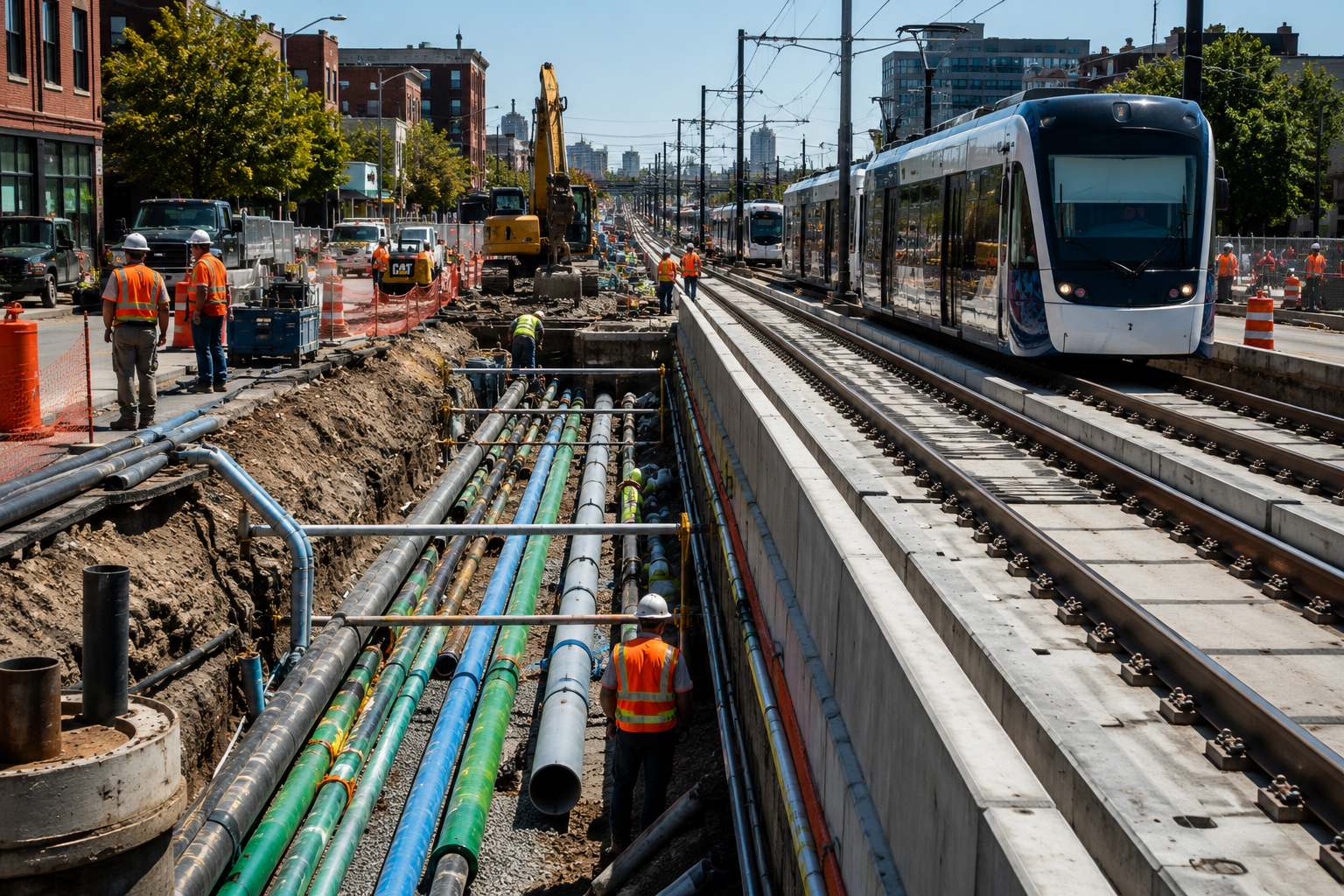
Utility conflicts are often more extensive and less predictable than on typical roadway work. Rail and transit corridors frequently run through older urban infrastructure with decades of utility installations that aren’t always accurately reflected in existing records. Subsurface utility engineering can reduce this risk but rarely eliminates it entirely, and unknown conflicts discovered during construction can trigger a relocation need that wasn’t part of the original utility coordination plan at all.
Multiple utility owners on a single corridor rarely move at the same pace. A single project segment might require coordination with a water utility, an electric utility, a telecommunications provider, and a gas utility, each with different internal processes, different budget cycles, and different urgency around this particular project relative to their own other priorities. The schedule risk isn’t the slowest utility. It’s the compounding uncertainty of coordinating several utilities simultaneously, each capable of independently becoming the pacing item.
Utility relocation delays cascade differently on linear transit projects than on a typical building project. A building project with a utility delay in one area can often continue other work elsewhere on the site relatively independently. A linear rail or transit alignment frequently can’t bypass a utility conflict the same way, because the alignment itself runs through the conflict point, meaning a utility delay at one location can block progress on an entire segment rather than being isolated to a small portion of the site.
What Treating This as Its Own Workstream Actually Requires
The schedule should show utility relocation with its own dedicated logic, tracking each utility owner’s specific commitments, milestones, and historical responsiveness separately, rather than aggregating all utility work into a single generic bar. Engagement with each utility owner should start as early as possible, often well before final design, because utility companies’ own internal planning and budget cycles frequently require lead time that has nothing to do with the transit project’s own schedule urgency. And the project’s risk register should explicitly reflect utility relocation as a third-party dependency with limited owner and contractor control, rather than as a standard construction risk that more contractor resources or schedule pressure can reliably resolve.
Why This Matters for How Owners Manage the Relationship
Recognizing utility relocation as fundamentally a coordination relationship rather than a controlled construction activity changes how an owner-side team should engage with it. It means investing real relationship management with each utility owner, understanding their internal processes and constraints well enough to realistically forecast their timeline rather than simply requesting a date and hoping it holds. It means escalation paths, through the utility’s own management structure or through regulatory or franchise leverage where it exists, need to be understood and available before they’re needed, not improvised after a utility relocation has already become the critical path.
The transit projects that manage this well aren’t the ones that pressure utility owners the hardest. They’re the ones that started the relationship early enough, and understood the utility owner’s own constraints well enough, that the coordination rarely needed to become adversarial in the first place.